Exploring the Science of Magnesium Chelate Malate


Magnesium chelate malate offers a unique way for you to support your health. This form combines magnesium with malic acid, making it easier for your body to absorb. Magnesium plays a vital role in muscle function, energy production, and bone strength. Many people worldwide face magnesium deficiency, especially older adults and those with certain health conditions. You can address this issue with magnesium chelates, which help boost magnesium levels and reduce stomach upset. Researchers have linked magnesium to better mood, stronger bones, and improved exercise performance.
What Is Magnesium Chelate Malate?
Definition
You may wonder what makes magnesium chelate malate special. This compound combines two important parts: magnesium and malic acid. Magnesium is an essential mineral that helps your muscles, nerves, and bones work well. Malic acid is a natural substance found in many fruits, such as apples. When you join these two, you get magnesium malate. This form stands out because your body can absorb it more easily than many other types of magnesium.
Here is a simple table to help you see the main components and how they work together:
Component | Description |
|---|---|
Magnesium | An essential mineral that supports many body functions and links with malic acid in this compound. |
Malic Acid | An organic compound from fruits that helps your body absorb magnesium better. |
Interaction | The combination forms magnesium malate, which improves absorption and reduces side effects. |
Magnesium malate is a chelated form. This means magnesium binds to malic acid. This bond helps your body use magnesium more efficiently. Other forms, like magnesium taurate or magnesium glycinate, use different partners. Magnesium malate often supports energy production and muscle relaxation. Many people choose magnesium chelate malate for these reasons.
How It’s Made
Manufacturers use careful steps to create high-quality magnesium malate. The process starts with dissolving L-malic acid in deionized water and heating it to the right temperature. They add magnesium carbonate or magnesium oxide slowly, making sure everything mixes well. The solution is filtered to remove any unwanted materials. Next, the liquid is concentrated and crystallized under reduced pressure. This step helps form pure magnesium malate crystals. The final product is granulated, making it easy for you to take as a supplement.
Here is a quick look at the main steps:
Dissolve L-malic acid in deionized water and heat to 75-85 °C.
Add magnesium carbonate or magnesium oxide in small amounts while keeping the temperature steady.
Filter the solution to remove impurities.
Concentrate and crystallize the mixture under reduced pressure to get magnesium malate.
Granulate the crystals for easy use.
This careful process improves the quality and purity of magnesium malate. You get a supplement that your body can use well. Magnesium chelate malate stands out because of its unique structure and the way it is made. This makes it a top choice for many people who want better absorption and fewer side effects.
Why Magnesium Matters
Essential Functions
You need magnesium for almost every part of your body to work well. This mineral helps you make energy, build strong bones, and keep your heart healthy. When you look at how your body uses magnesium, you see it acts in many ways. Here is a table that shows some of the most important jobs magnesium does for you:
Physiological Function | Description |
|---|---|
Enzymatic Reactions | Helps over 300 enzymes work, including those for energy and protein. |
Cardiovascular Health | Keeps your heart rhythm steady and supports healthy blood pressure. |
Bone Health | Helps your body use calcium and keeps bones strong. |
Nervous System | Calms your nerves and helps you sleep better. |
Muscle Function | Relaxes your muscles and prevents cramps. |
Metabolic Health | Supports insulin action and helps control blood sugar. |
Energy Production | Needed for making ATP, your body’s main energy source. |
Nucleic Acid Synthesis | Helps your body make DNA and RNA. |
You depend on magnesium for energy every day. Your cells use it to make ATP, which powers your muscles and brain. Good magnesium status helps you feel strong and alert. If your dietary magnesium intake is too low, your magnesium status can drop. This can affect your bones, heart, and even your mood.
Deficiency Signs
When your magnesium status falls, your body gives you warning signs. You may notice muscle spasms or tightness. Some people feel weak or tired. Others have trouble sleeping or feel anxious. Here are some common signs that your magnesium status may be low:
Muscle weakness
Constipation
Fatigue
Palpitations
Insomnia or sleep problems
Low mood
Anxiety
You may also see headaches, loss of appetite, or even heart rhythm changes. Chronic magnesium deficiency can lead to bigger health problems, such as type 2 diabetes, heart disease, or osteoporosis. Keeping your magnesium status in a healthy range protects you from these risks. You can support your magnesium status by eating foods rich in magnesium or by using supplements like magnesium chelate malate.
Note: If you think your magnesium status is low, talk to your healthcare provider. They can help you check your levels and suggest ways to improve your magnesium status.
Unique Properties
High Bioavailability
You want your body to get the most out of every supplement you take. Magnesium chelate malate stands out because your body can absorb it very well. High bioavailability means your body takes in more magnesium from each dose. Many other forms of magnesium, like magnesium oxide or magnesium sulfate, do not absorb as well. When you use magnesium chelate malate, you help your body get the magnesium it needs for energy, muscle function, and bone health.
Your digestive system can break down magnesium chelate malate easily. This helps magnesium move from your gut into your bloodstream. You may notice fewer stomach problems, such as diarrhea or cramps, compared to other magnesium supplements. Many people choose this form because it works better for them and causes fewer side effects.
Tip: If you want to improve your magnesium levels, look for supplements with high bioavailability. This helps you get the most benefit with less waste.
Role of Malic Acid
Malic acid plays a key role in making magnesium chelate malate so effective. When magnesium bonds with malic acid, your body absorbs it more quickly and uses it better. Malic acid comes from fruits like apples, and it helps your body use magnesium for important tasks.
Research shows that magnesium malate absorbs better than other forms, such as magnesium citrate or magnesium oxide. Malic acid helps magnesium pass through your gut wall and enter your blood. This makes magnesium chelate malate a smart choice if you want to support muscle health or fight fatigue.
You may also notice more energy when you use magnesium chelate malate. Malic acid helps your cells make energy, so you feel less tired. This combination supports your muscles, nerves, and bones in many ways.
Here is a quick table to show how malic acid helps:
Benefit of Malic Acid | How It Supports Magnesium |
|---|---|
Improves absorption | Helps magnesium enter your blood |
Boosts energy production | Supports cell energy processes |
Reduces stomach upset | Makes magnesium easier to digest |
You can trust magnesium chelate malate to give you the support you need for daily health.
Absorption & Comparison
How the Body Absorbs It
Your body needs to absorb magnesium for it to work. Magnesium chelate malate stands out because your body takes it in more easily than many other forms. This happens because magnesium binds to malic acid, which helps it move through your gut wall. When you take this form, your digestive system uses both passive and active ways to absorb it. The bond with malic acid lets magnesium pass into your blood faster.
You can see how this works in the table below:
Mechanism | Description |
|---|---|
Organic vs Inorganic Absorption | Organic magnesium compounds, like magnesium malate, absorb better than inorganic ones. |
Tissue Transition | Magnesium chelate malate moves into tissues more easily, showing higher bioavailability. |
Absorption Mechanisms | Your body uses passive paracellular pathways and electrochemical gradients to absorb magnesium. |
Magnesium chelate malate gives you more magnesium per dose. Your body does not waste as much. You get better results for your muscles, nerves, and bones.
Other Magnesium Forms
You may see many types of magnesium supplements on the shelf. Some common forms include magnesium oxide, magnesium citrate, and magnesium sulfate. These forms do not absorb as well as magnesium chelate malate. For example, magnesium oxide often passes through your gut without much absorption. Magnesium citrate absorbs better than oxide, but it can cause stomach upset for some people.
Here is a quick comparison:
Magnesium chelate malate: High absorption, gentle on the stomach, supports energy.
Magnesium oxide: Low absorption, may cause digestive issues.
Magnesium citrate: Moderate absorption, can lead to loose stools.
Magnesium sulfate: Used in hospitals, not ideal for daily use.
You want a supplement that gives you the most magnesium with the least side effects. Magnesium chelate malate offers this balance. You get more benefit from each dose, and your body uses it well.
Tip: Choose magnesium chelate malate if you want a form that absorbs well and supports your health without causing stomach problems.
Health Benefits of Magnesium Chelate Malate
Muscle & Exercise Support
You need strong muscles for daily activities and exercise. Magnesium chelate malate helps your muscles work better and recover faster. Many research studies show that magnesium supports energy metabolism and normal muscle function. You can see improvements in muscle performance when you keep your magnesium levels healthy. Animal research shows that magnesium supplementation increases glucose availability and reduces lactate buildup during exercise. This means you may feel less tired and recover more quickly. Human research also finds that magnesium supplementation improves muscle strength, such as quadriceps torque, and boosts performance in both aerobic and anaerobic exercises.
Magnesium helps your muscles contract and relax.
You may notice less soreness and better endurance.
Athletes often use magnesium supplementation to support training and recovery.
If you want to improve your exercise results, magnesium chelate malate offers reliable support for your muscles.
Energy & Fatigue
You need energy to get through your day. Magnesium chelate malate plays a key role in helping your body produce energy. Research shows that people with fibromyalgia and chronic fatigue syndrome often have low magnesium levels. Magnesium malate helps restore these levels and supports energy production. You may feel less tired and more active when you use magnesium supplementation. Magnesium malate boosts ATP production, which gives your muscles the energy they need. People with chronic fatigue or fibromyalgia report feeling more energetic and less fatigued after using magnesium malate.
Magnesium malate supports energy for your muscles and brain.
You may experience less fatigue and more stamina.
Magnesium supplementation is especially helpful for those with chronic fatigue or fibromyalgia.
Tip: If you feel tired often, magnesium chelate malate may help you regain your energy.
Mood & Mental Health
Your mood and mental health depend on many factors, including magnesium. Research links low magnesium levels to depression and anxiety. A review of 18 studies found that magnesium supplementation decreased anxiety in most participants. A randomized clinical trial in 2017 showed that magnesium helped adults with mild-to-moderate depression. Systematic reviews highlight the connection between magnesium and depression, as well as other mental health disorders. You may notice better mood and less anxiety when you keep your magnesium levels healthy.
Study Type | Findings |
|---|---|
Review of 18 studies | Magnesium decreased anxiety in most participants. |
Randomized clinical trial (2017) | Magnesium helped with mild-to-moderate depression. |
Systematic review | Low magnesium linked to depression and anxiety. |
Research continues to explore how magnesium supplementation affects mental health. You can support your mood and reduce stress by maintaining good magnesium levels.
Note: If you struggle with mood or anxiety, magnesium chelate malate may offer gentle support.
Blood Sugar & Metabolism
You need stable blood sugar for good health. Magnesium chelate malate helps regulate blood sugar and supports metabolic health. Research shows that magnesium improves insulin resistance, which is important for controlling blood sugar. Higher magnesium intake lowers the risk of developing type 2 diabetes. Magnesium supplementation supports insulin sensitivity and glucose metabolism in people with diabetes. Magnesium activates enzymes that help your body use glucose, keeping your blood sugar steady.
Magnesium helps your body use insulin better.
You may lower your risk of diabetes with regular magnesium supplementation.
Stable blood sugar supports your overall health.
If you want to support your metabolism, magnesium chelate malate is a smart choice.
Bone & Vitamin D Support
You need strong bones for lifelong health. Magnesium chelate malate plays a vital role in bone formation and vitamin D metabolism. Research shows that 60% of your magnesium is stored in bone tissue. Magnesium is necessary for proper bone formation and calcium metabolism. Low magnesium levels can lead to decreased bone density and higher risk of osteoporosis. Magnesium deficiency affects bone health directly and indirectly, promoting bone loss. Magnesium acts as a cofactor for vitamin D synthesis and activation, helping your body absorb both nutrients.
Evidence Type | Findings |
|---|---|
Magnesium Role | Essential for bone health, with 60% stored in bone tissue. |
Bone Formation | Necessary for proper bone formation and calcium metabolism. |
Deficiency Impact | Associated with decreased bone density and increased osteoporosis risk. |
Evidence Type | Findings |
|---|---|
Magnesium Deficiency | Affects bone directly and indirectly, promoting bone loss. |
Vitamin D Interaction | Magnesium is a cofactor for vitamin D synthesis and activation. |
Homeostasis | Establishes a feedback loop for magnesium absorption. |
Evidence Type | Findings |
|---|---|
Magnesium's Role | Pivotal for bone health, affecting stiffness and cell activity. |
Vitamin D Relationship | Essential for vitamin D synthesis, enhancing magnesium absorption. |
You can protect your bones and support vitamin D metabolism with magnesium supplementation.
Pain & Chronic Conditions
You may experience pain from time to time, or you may live with chronic conditions. Magnesium chelate malate helps manage pain and supports your health. Research shows that magnesium supplementation improves pain management and reduces inflammation. Low magnesium intake links to chronic pain and other clinical conditions. Oral magnesium reduces pain in people with chronic pain. Magnesium acts as a calcium antagonist, which may help lower inflammation and pain. Research has studied magnesium for migraine headaches, fibromyalgia, and chronic low back pain.
Magnesium supplementation may help reduce pain and inflammation.
You may find relief from chronic pain with regular magnesium intake.
Magnesium supports your body in managing clinical conditions.
If you deal with pain or chronic health issues, magnesium chelate malate may offer gentle relief.
Sleep & Immune Function
You need restful sleep and a strong immune system to stay healthy. Magnesium chelate malate supports both. Research shows that magnesium helps your body relax and sleep better. You may notice improved sleep quality and fewer sleep problems with magnesium supplementation. Magnesium also supports immune function by helping your body fight off infections and reduce inflammation. Good magnesium levels help your body recover and stay strong.
Magnesium helps you fall asleep and stay asleep.
You may get sick less often with healthy magnesium levels.
Magnesium supplementation supports your body’s natural defenses.
Tip: If you want better sleep and a stronger immune system, magnesium chelate malate can help.
Cancer Risk & Longevity
You may wonder if magnesium chelate malate affects cancer risk or longevity. Research shows a significant inverse association between dietary magnesium intake and cancer mortality risk. An increase of 100 mg per day in dietary magnesium links to a 5% lower risk of cancer mortality. Higher dietary magnesium intake also associates with lower risk of colorectal tumors and lung cancer. However, research finds no significant link between magnesium supplementation and cancer incidence or longevity. You can lower your cancer risk by eating magnesium-rich foods, but supplements do not show the same effects.
Higher dietary magnesium intake lowers cancer mortality risk.
No link exists between magnesium supplementation and cancer incidence.
Eating magnesium-rich foods supports long-term health.
If you want to support longevity, focus on a diet rich in magnesium.
Safety & Dosage
Recommended Amounts
You need to know how much magnesium chelate malate is right for you. Health experts set daily recommendations based on age and gender. The table below shows the recommended daily amounts for different groups:
Age | Male | Female |
|---|---|---|
Birth to 6 months (AI) | 30 mg | 30 mg |
7–12 months (AI) | 75 mg | 75 mg |
1–3 years (RDA) | 80 mg | 80 mg |
4–8 years (RDA) | 130 mg | 130 mg |
9–13 years (RDA) | 240 mg | 240 mg |
14–18 years (RDA) | 410 mg | 360 mg |
19–30 years (RDA) | 400 mg | 310 mg |
31–50 years (RDA) | 420 mg | 320 mg |
51+ years (RDA) | 420 mg | 320 mg |
Pregnant (18+) | 350-360 mg | N/A |
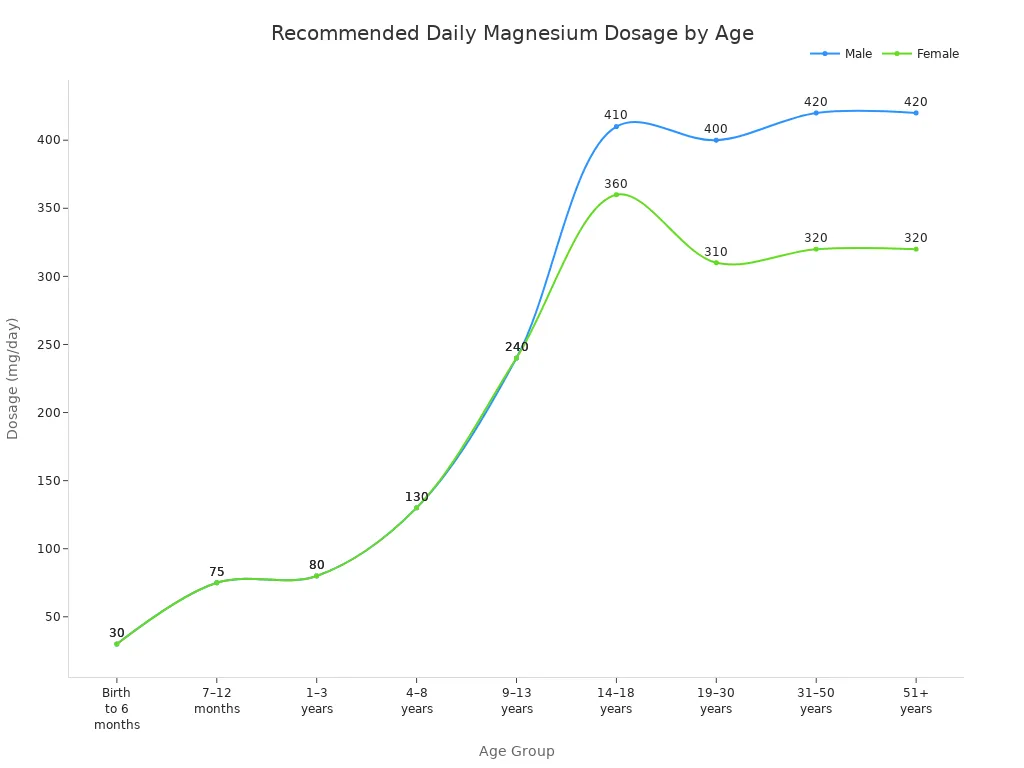
You may need more magnesium if you have certain health conditions, such as high blood pressure, type 2 diabetes, or if you use alcohol often. Always check with your healthcare provider before changing your supplement routine.
Who Should Use It
Some people benefit more from magnesium chelate malate. You may need extra magnesium if you have a deficiency, diabetes, or if you are pregnant. The table below highlights who may benefit most:
Population | |
|---|---|
Magnesium Deficient | Improved recognition and treatment of magnesium deficiency in clinical settings. |
Diabetic Individuals | May lower risk of developing diabetes and improve insulin sensitivity. |
Pregnant Women | Associated with lower frequency of preterm births and better pregnancy outcomes. |
You may also benefit if you eat a diet low in magnesium-rich foods. Pregnant women often need more magnesium to support healthy pregnancy outcomes. People with diabetes may see better blood sugar control with regular magnesium intake.
Note: If you have kidney problems or take certain medications, talk to your doctor before starting magnesium supplements.
Side Effects
Most people tolerate magnesium chelate malate well. You may notice mild side effects, especially if you take too much. Common side effects include:
Nausea
Diarrhea
Stomach cramps
Serious allergic reactions are rare but can happen. Watch for symptoms like rash, severe dizziness, or trouble breathing. People with kidney disease should use caution, as high magnesium levels can be harmful. Very high doses can be toxic and may interfere with some medications.
Tip: Start with the recommended dose and watch for any side effects. If you feel unwell, stop taking the supplement and seek medical advice.
Choosing a Supplement
What to Look For
When you choose a magnesium chelate malate supplement, you want to make sure you get a product that is safe and effective. Look for brands that use third-party testing. This means an outside company checks the product for quality and purity. Certifications like Non-GMO or NSF Certified can also show that the supplement meets high standards. You should check the dosage per serving and see if it matches your needs. Some products offer higher doses, while others focus on purity or special blends.
Here is a table to help you compare some popular options:
Product Name | Third-Party Tested | Certifications | Price | Dosage per Serving | Pros/Cons |
|---|---|---|---|---|---|
NOW Foods Magnesium Malate | Yes | Non-GMO | $25.99 | 113 mg | Pros: Cost-effective; Cons: No major certifications, lower dosage |
Thorne Calcium-Magnesium Malate | Yes | NSF Certified | $40 | 100 mg | Pros: Premium ingredients; Cons: Not pure magnesium malate |
Source Naturals Magnesium Malate | No | N/A | $12.25 | 425 mg | Pros: Higher dosage; Cons: Not third-party tested, high volume of capsules |
BetterVits Magnesium Complex | No | N/A | $30 | 225 mg | Pros: Potent blend; Cons: Not solely magnesium malate |
Tip: Always read the label and check for third-party testing to make sure you get a quality supplement.
Usage Tips
You can get the most out of your magnesium chelate malate supplement by following a few simple tips:
Take your supplement in the morning or afternoon to support energy production.
If you also take zinc, space it at least two hours apart from magnesium to help your body absorb both minerals.
Pick a regular time each day for your supplement. This helps keep your magnesium levels steady.
Adjust the timing based on your goals. For example, take it earlier for energy or later for muscle recovery.
Choose the form of magnesium that matches your health needs.
Stay consistent with your routine to get the best results.
Note: Talk to your healthcare provider before starting any new supplement, especially if you have health conditions or take other medications.
Magnesium chelate malate gives you several unique advantages over other supplements:
High bioavailability for better absorption than magnesium oxide.
Supports energy, muscle recovery, and reduces soreness, especially for athletes.
Helps with sleep, mood, and blood pressure regulation.
Safety Aspect | Summary |
|---|---|
Bioavailability | |
Long-term Use | Generally safe when taken as recommended. |
Consultation | Always talk to your healthcare provider if you have kidney or digestive issues. |
You can take magnesium chelate malate at any time of day. Not everyone needs a supplement, so check with your doctor before starting, especially if you have health conditions or take other medications.
FAQ
What makes magnesium chelate malate different from other magnesium supplements?
You get better absorption with magnesium chelate malate. Your body uses it more easily than many other forms. This means you may see more benefits and fewer stomach problems.
Can you take magnesium chelate malate with other vitamins or minerals?
You can take magnesium chelate malate with most vitamins and minerals. If you use zinc, take it at a different time. This helps your body absorb both nutrients well.
How long does it take to feel the effects of magnesium chelate malate?
You may notice changes in energy or muscle comfort within a few days. Some people need a few weeks to see full benefits. Your results depend on your starting magnesium levels.
Is magnesium chelate malate safe for children and teens?
Children and teens can use magnesium chelate malate if they need more magnesium. Always check with a healthcare provider for the right dose. This keeps you safe and healthy.
Does magnesium chelate malate help with asthma symptoms?
Some studies look at magnesium and asthma. Magnesium may help relax airway muscles. You should talk to your doctor before using magnesium chelate malate for asthma.